Thursday, December 10, 2015

Skating on the Rideau Canal: the Modern Day Walt Whitman


Skating on the Rideau Canal: the Modern Day Walt Whitman


Walt Whitman was one of the most famous poets of the romantic era. He was known as the father of free verse poetry, in which he commonly wrote in prose-like sentences. Whitman’s use of repetition and rhyme adds a poetic, rhythmic and harmonious value to his poems. This enhances the common, direct, and simple diction that Whitman utilizes. Whitman’s writing can be compared to skating down the Rideau Canal in Ottawa, Canada. The Rideau Canal is a long river that runs through the heart of downtown Ottawa; each winter thousands of skaters traverse the frozen river on their skates. Both Whitman’s writing and skating down the Rideau Canal contain limited structure, have a simplistic principle and an underlying sophisticated beauty.

One of Whitman’s most popular free verse poems is “Song of Myself.” The poem is a lengthy story separated into numerous cantos. Each canto contains lines that resemble the manner in which a person would speak. “I wish I could translate the hints about the dead young men and women / What do you think has become of the young and old men?” (Whitman 25-27) from canto 6 of “Song of Myself” demonstrates that Whitman’s writing has limited structure and varied syntax; he alters his sentence length and includes questions within his writing. Similarly, skating down the Rideau Canal lacks organization and structure. Skaters wear different clothes, skate at different speeds, travel in different sized groups and stop skating when they desire. The only stipulation is that everyone must be skating in the same direction, similar to everyone reading Whitman’s poems from left to right, top to bottom. Each skater determines the length, intensity, and speed of their skate down the river, with no two skating experiences being identical; just as each line in Whitman’s poems are unique in style.

Whitman’s writing is usually centered on simplistic principles that involve oneself. In “Song of Myself” Whitman begins the poem by writing “I celebrate myself, and sing myself / For every atom belonging to me as good belongs to you” (Whitman 1-3). In this excerpt, Whitman writes in the first person, however speaks for humanity as a whole; one should celebrate who they are and what they own. Whitman elicits positivity and self-reflection to many of his readers. Skating down the rideau canal has a similar effect; skating is an individual activity that brings joy to each skater. Skaters on the Rideau Canal are united by performing the same activity, sharing the same ice, and enjoying the same weather, similar to Whitman’s writing uniting his readers. Whitman’s writing is direct and intended for the common man; those who young and old, the foolish as much as the wise. Skating down the Rideau Canal has a similar invitation because it is open to the public and the only requirement is that one must be wearing skates; no previous skating experience is required. The intention is that everyone will be able to enjoy the pleasure of skating. The completion of reading “Song of Myself” is usually accompanied by a sense of deep thought and self-reflection. Skating down the entire Rideau Canal is accompanied by a similar feeling after the five mile long skate, that leaves the soul clear and calm. Whitman’s writing and skating down the Rideau Canal both provide similar experiences of beginning and completing a task, while uniting participants through mutual feelings of achievement.

Whitman’s writing contains underlying sophistication that is not immediately apparent. Whitman wrote in “Time to Come,” “Hangs round thee, and the future state / That mystery of fate” (Whitman 2-4). The rhyming of “state” and “fate” provides fluid language for the reader; this diction also provides juxtaposition between the physical state of a person and the theoretical notion of the inevitability of one’s destiny (http://www.poetryfoundsation.org/learning/guide).

The use of rhyming within Whitman’s poetry is similar to rhythmic strides of people skating down the Rideau Canal. The measured crackling of the ice under each stride is similar to the rhyming of Whitman’s poetry that allows the reader to read the poem smoothly. Whitman uses repetition to emphasize his main ideas and add rhythm to the piece. In Whitman’s “O Captain! My Captain!” Whitman repeats “O Captain! my Captain!” to begin multiple stanzas in the poem. This provides the effect that Whitman may be lamenting over the assassination of Abraham Lincoln, a beloved US president. Skating down the Rideau Canal is similar in the repetitive motion of a skating stride. The majority of the canal is a straight line path, so the unchanging, casual forward strides can provide a soothing and tranquil journey down the canal. Although not evident at first, both Whitman’s poetry and skating down the Rideau Canal contain subtle details that make the experience more enjoyable, fluid and exciting. While Whitman utilizes literary devices to enhance the reading experience, the skating experience is influenced by the temperamental beauty of a Canadian winter.

Reading Whitman’s poetry and skating down the Rideau Canal are different activities, however the two pursuits share many similarities. Both activities provide participants with a sense of self reflection and relaxation while navigating through a straightforward passage. Whitman’s continued popularity stems from his ability to appeal to the common reader by providing the reader with a depth of sophistication and a sense of fulfillment unique to each reader. Skating down the Rideau Canal is popular for its ability to unite the masses with a different experience each season because each skater controls his or her own journey. Although Whitman’s work and the Rideau Canal are both centuries old, they are both timeless activities that bring a new perspective depending on the reader or the skater, who each infuse their individuality into their experience to make it meaningful for them.


Wednesday, December 9, 2015

Wiesmann & Whitman


When I was a boy, my dad and I often toured public exhibitions of private automobile collections. Every time my eyes caught the voluptuous curves of a Wiesmann I was starstruck. This lust for Wiesmanns only increased in my teen age years when my testosterone fueled desire to impress women took over. When I heard the personal anecdote of one of my family friends, who test drove a Wiesmann and was immediately engaged by the beautiful woman in the car next to him at an intersection, the love was complete. So when my english teacher made me write an essay on Whitman I automatically thought of the phonetically similar and equally magical Wiesmann.

Wiesmann was a relatively small German car manufacturer based in Westphalia, Germany. Martin and Friedhelm Wiesmann founded Wiesmann in 1988 with a mission to produce custom made, rare, high quality sports convertibles. Similar to Walt Whitman’s poetry the design of Wiesmann cars is grounded in proven classics but incorporates new elements. Both Wiesmann and Walt Whitman use this melange of old and new to create an iconic and unique style.

Both Wiesmann and Whitman base their pieces on tried and tested techniques. Whitman uses motives popularized by fireside poets and European Romanticism. He often explores people around him through his own perspective. An example of this is Canto 12 in “Song of Myself”, where he examines the butcher boy from the first person perspective, “The butcher-boy puts off his killing-clothes, or sharpens his/ knife at the stall in the market/ I loiter enjoying his repartee and his shuffle and break-down” (Whitman, Canto 12). This intuitive exploration of another person’s emotions is prevalent in both European Romanticism and previous fireside poetry. Whitman also used the aria and recitative music found in Opera. He values fluidity in the music and the sequence of his lines. Wiesmann emphasizes this fluidity in the silhouette of its cars. Wiesmann constructed a flat and swift contour made famous by previous convertible design icons like the Jaguar E Type and the 1955 Mercedes-Benz 300 SLR (I challenge you to click on these links without drooling). Wiesmann also appropriated the classic grille design popularized by Alfa Romeo. Furthermore, Wiesmann’s cylindrical headlights hint at those of icons like the Jaguar XK 10. Furthermore the use of quilted car upholstery alludes to the interior of a classic bentley. Circular gauges underscore this retro appearance. The bread and butter of Wiesmann cars, however, are their sturdy and tried BMW M engines. Instead of venturing into their own motor experiment, they relied on a renowned engine manufacturer. For both Wiesmann and Whitman innovation is only possible on top a sturdy framework of proven methods.


Whitman and Wiesmann sought to weave in elements of innovation throughout their works. Although Whitman insured that his works used vernacular language he often incorporated his own eccentricities, such as the word “presidentiad” and the spelling of Canada with a K. Although Whitman’s form often seems unorganized and arbitrary it is indispensable to the creation of his unique voice. “Song of Myself” expresses a deep level of observation and exploration of Whitman’s surroundings that would not have been possible in a strict framework of rhyme and meter. Whitman’s experimentation with meter, rhythm, and form was indispensable for poetic innovation and progress from the already written and rhymed. An example of one of his unique techniques was his cataloguing and listing of persons, animals, and places in “Song of
Myself”. He rightly described his own poetry as "a new and national declamatory expression". Wiesmann also honors this commitment to the law of changing times. They apply their classic design elements in an aggressive and wide body. The fenders and rear are modern and push the boundaries of contemporary car design. Wiesmann emphasizes this commitment to innovation not only in their design but also in technology. While their first car only had 231 horsepowers and took a whole 5.9 seconds from 0-100 km/h their newest model boasts 420 horsepowers and takes a lighting fast 4.1 second to reach 100 km/h. The Wiesmann MF4 has all the features we lazy and entitled motorists enjoy while keeping the weight at an impressive 1310 kg. Whitman and Wiesmann both have this commitment to not only visible sportiness but also what really counts, under the hood power.

Although Walt Whitman and Wiesmann share several similarities they also share significant differences. Most significantly, Whitman had a much greater contribution to poetry than Wiesmann had to the car industry. Wiesmann remained on the fringes of the car industry, resulting in its 2014 disbandment. Because of its relative insignificance, its agreeable design, and its non-establishment threatening business model (BMW owned shares in Wiesmann) Wiesmann did not face backlash from critics and consumers. You probably saw the car above and were just infatuated as I was as a 8 year old boy. Whitman, however, initially faced immense criticism for his new form and style, a critic even described him as “chaotic and fragmentary.” After reading some of this poetry you might be convinced that this critic is right on the money. I certainly thought so after my first few cantos, but I experienced a conversion experience. Although Whitman won the hearts of many during his lifetime his works were only recognized for their grandeur posthumously, which is probably why we are studying so extensively in high school. This struggle for recognition and revolutionary ideas is the reason for Whitman’s greatness and Wiesmann’s relative triviality.

Whitman and Wiesmann are both parables of successful innovation. While Whitman had a greater influence in his field, both Wiesmann and Whitman show that innovation is only possible on top of a sturdy fundament of tried and tested technology. Whitman demonstrates that innovation is not a smooth process and that the recognition of one’s innovation is an even rougher one. In addition, Wiesmann teaches us that failing is a possibility and not fatal. Let's keep in mind these two examples to motivate and instruct us in the process of creating something new, however small, personal, or insignificant.

Tuesday, December 8, 2015

Man's Carnal Desire: SEX and authenticity


I know you stopped look at my blog post because this picture intrigued you. Whether you liked it or not, it evoked an emotion. Sex sells, Walt Whitman and the creators of Commedia dell’arte knew that. Today boys as young as twelve years old spend hour a week watching pornography videos. The imagination of the young boys is filled, and inspired through these films. The films are not only an exposition unorthodox sexual positions and encounters of what these boys will never have , but they are a form of art. These films are viewed as despicable by many. Their crude and authentic nature draws millions of viewers to them, aside from their negative connotation. This art has enabled young boys to escape and feel free. People have always been oppressed throughout history, and expression frees the oppressed. Since the beginning of time, art has liberated the human soul. In response to the European political and economic crisis in the sixteenth century, a new form of theater known as Commedia Dell’arte arose. The majority of europeans were illiterate, poor, and hungry; they were starving for something. Theater fed their mind, body, and soul. Just as Commedia Dell’arte rose, Walt Whitman arose in a time of oppression.African American people in nineteenth century America were enslaved, discriminated against and treated as subordinate. A similar situation of oppression entrapped women and they faced  the inability to work, vote, and have a voice in society: Slaves and women were viewed and treated as property of the white man. Whitman’s famous “Song of Myself,” declares equality for everyone, including blacks and women; the powerful words of Whitman inspired millions.  Whitman appealed to the common man. These forms of art were viewed by many as crude and un-tasteful. The crude and authentic nature of Walt Whitman’s poetry, and Commedia dell'arte plays revolutionized the art world.


The sex, and exposure of things people have never seen before, drew and intoxicated common dwellers to their art. This work was bold!  The exposure of man’s sexual desire in Whitman’s poems and in Commedia dell’arte awakened the curiosity to explore the depths of sexuality. Throughout history sex has had negative connotations. The bible refers to it as a sin, yet naturally sex is something that is necessary for the human species longevity. Sex has enabled man to be free! Those portrayed as “sexual beings,” have been viewed as menaces to society. Ignoring sex’s negative connotation, Walt Whitman and Commedia de’ll arte expose man’s sexual nature. 


Whitman spoke freely of not only naked bodies, but men’s naked bodies in his “Song of Myself.” He embraces the natural and  undisguised qualities of man naked. Whitman writes: “Twenty-eight young men bathe by the shore,/ Twenty-eight young men and all so friendly; / Twenty-eight years of womanly life and all so lonesome”(Whitman,Canto 11). Whitman applauses nudity and fraternity alongside each other, something unheard of in his time period (Whitmanarchive.org). Whitman’s exposure of man’s nudity and fraternity awakened visual artists of his time period to explore sexuality. Thomas Eaken’s painting The Swimming Hole depicts six naked men in a pond together. The swimming hole can be a twenty first century depiction of guys in a locker room. These men are unbothered by the nakedness of the others, and they embrace their natural form. The men aren’t viewed as gay because they are showing together, but they are seen as “bros.” Manly love and sexuality in the painting  is conveyed in a way similar to Whitman’s poetry;  in the piece, each man basks and embraces his nakedness.


Similarly, Commedia Dell'arte exposure of sex, lust, and womanhood inspired other visual artists to explore sex and the female body. The 15th century’s Commedia dell’arte was one of the first art forms in Europe to portray themes of lust and embrace sex as a natural occurrence. This belief was heinous to the church, and its beliefs on celibacy and purity (Theatrehistory.com). The church had the same, if not more,  power than the monarchs in the 15th century.The church forbade people from attending theatre, and it often banned shows for being immoral. Commedia’s sexual nature inspired many erotic, shirtless paintings of women in the fontainbleau. One of which include the painting Gabrielle d'EstrĂ©es et une de ses soeurs. The painting depicts two naked women in the bath; one is pinching the nipple of the other. If it were in our times, it would basically translate as two girls at a sleepover kissing a girl for the first time out of curiosity. French historian Pierre de Bourdeille adds that the women “touch,feel, handle, stoke, intertwine, and fondle with each other” (Lives of Friars & Gallant Ladies).  The painting, by some, is  viewed as homoerotic. In the 19th and 20th centuries this painting was used to illustrate lesbianism for the LGBT community. Historians and critics often acknowledge its homoeroctism. Whitman’s and Commedia’s lustful and crude style illustrated to other artists that sex was ok! It was really something that everyone did! It is how human exist, that is how humans are created: sex! 


Did you know that women and men were equal? Did you know that blacks and whites are equal? You are so much more advanced than people in Whitman's era and people in the fifteenth century! The plays of Commedia de’ll arte illustrated equality and further opened the artistic community’s eyes to acceptance of others. Historically, the white man’s domination of earth, left blacks and women as inferior. Women and blacks were not even considered in the United States Constitution, the United States “the land of the free,” did not genuinely let their people free. Women were bound to the house, and slaves were bound to the plantations. Commedia’s  acceptance of women on the stage remains as its boldest attribute Prior to Commedia, men would portray female characters on stage with the belief that women were inadequate for acting. Men would overplay women’s sexuality and use fake boobs. With women on stage, women could go a step further and show real cleavage!In Commedia, women played alongside men. This was the first time in theatre where women proved their capabilities equal to men’s. Isabella Andreini was one of the most famous female actresses of her time; she and her husband owned the most popular Commedia troupe throughout Europe (Humanracetheatre.org).  Her fame showed young girls within all of Europe that a woman could accomplish anything; a woman could own the most influential troupe to walk the earth. Isabella Andreini was a pre-twentieth century Audrey Hepburn! Commedia revolutionized theatre, and soon after more women began to become more involved in the arts.


I know that most high school students dreaded chemistry: the sight of the test tube, the smell of the goggles used and abused by hundreds of other oily-skinned students. Whitman was pretty advanced at science, and he used his chemistry knowledge to his advantage. Whitman was one of the first poets to freely speak his mind. Instead of writing, “Yeah, Blacks are kind of good, they are kind of like me. We should kind of free them.” He wrote “for every atom belonging to me as good as belongs to you,” ---The guy would've certainly gotten a higher grade than I did in chemistry--Whitman clearly declares all of God’s creatures perfect, and all of them equal(Whitman, Canto 1). Whitman was so straightforward that instead of writing “Yeah, women are kinda cool. They have nice body parts, and they’re nice to look at. They are almost as good as me, but…,” Whitman clearly writes “I say it is as great to be a women as to be a man.” Whitman’s honesty and straightforwardness made most abolitionist poets look like they were dancing around the subject. There were few men during Whitman’s era who spoke out against sexism. Whitman proudly declared women’s equality. Tons of critics bashed Whitman's work, and he would be considered a twenty-first century Nicki Minaj with all of the disgrace he received. Whitman, like Minaj held his head up high and kept on doing what he loved. Whitman was bold in writing explicitly about man and women’s bodies, but he did it because he thought it was right. The man believed that all of God’s creatures were beautiful regardless of color; whether they were “Red, yellow, white, gree, or violet.” Each person’s unique qualities, to Whitman, was made for a purpose, and he believed that embracing these qualities would strengthen the human. Commedia’s bold casting of women in plays and Whitman’s praising of blacks and women illustrated equality and opened the eyes of others.


Through authenticity, boldness, and crudeness Walt Whitman’s “Song of Myself,” and Commedia dell'arte performances were able to similarly make a lasting impact upon their societies. The sight of a women on stage excited men-- most likely the sight of a woman other than their wife was what really excited them. Women on the stage inspired other women and young girls; they were the symbols of girl power! Themes of sex, nudity, equality, and greed were demonstrated in these works. Whitman and Commedia's creation of new art form created an authentic and intoxicating product. People were drawn to the poems and the plays, just like young boys are drawn to their computer screens and porn subcriptions. By embracing the human’s carnal desires, millions of eyes were opened, people were like "Oh my god, sex is totally natural and I shouldn't be ashamed of my body." Whitman inspired others to embrace others, despite their visible differences. Commedia inspired others to look beyond the church and other high powers, and look to oneself to figure out who they truly were. Commedia plays showed the world that women were capable of everything a man was, and in its time period enabled women to take more steps to affirming their equality. Whitman’s powerful and straightforward wording in free-verse showed the world that one could speak his mind freely; even a common man. The change from strict literate poetic end rhymes and other poetry normalities were immediately changed, and whitman’s natural free-flowing verses enthralled society. Commedia and Whitman together taught humans that sex was a natural action performed by humans, and it was not to be shamed. Commedia and Whitman inspired thousands of artists to go beyond their comfort zone and explore man and women; humans are meant to inspire, create and learn. Through art and influential pieces, human development has been able to continue. Authenticity has liberated man and woman and enabled them to inspire.

Whitman and Basquiat: Similarly Dissimilar

Walt Whitman was arguably the most influential poet in American history. Today, it would be difficult to compare anyone to an artist so influential, and few titans similar to Whitman exist in any field for that matter. However, it would be unreasonable to neglect the influence and nuance of an artist so similar to Whitman as Jean-Michel Basquiat. The similarities go far beyond Basquiat and Whitman’s comparable legendary status in America’s artistic history. Whitman and Basquiat possessed similarities in the contemporary and revolutionary qualities of their work, in the themes they explored, especially in regards to individualism, and in the influence and legacy they left behind, as artists, and commentators on American society.
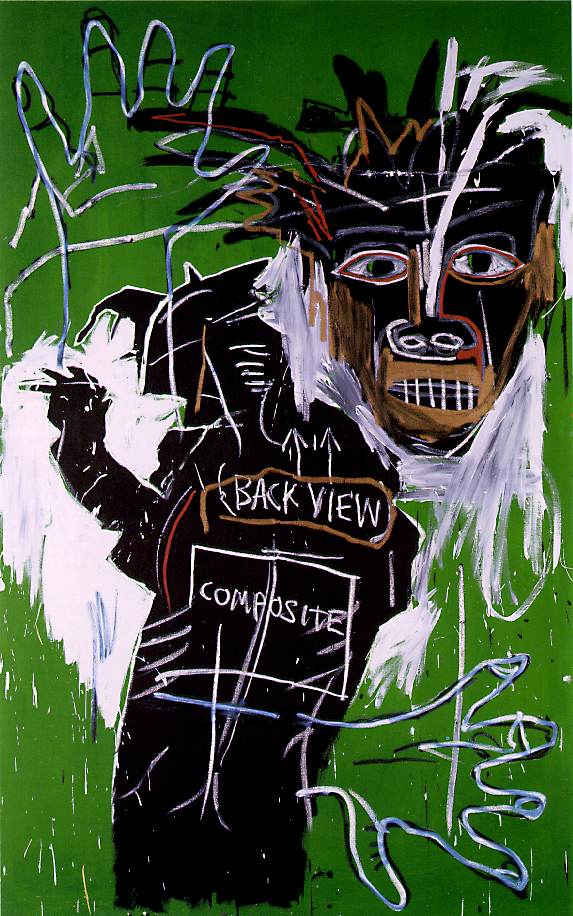
Whitman and Basquiat’s works were imbued with innovation and revolutionary style. Whitman broke away from the immensely popular fireside poets, deviating far from the conventional aspects of their poetry. Whitman’s poetry was almost void of any meter, rhyme of any sort, and musicality. This open form of poetry was referred to as free verse. For his use of it, Whitman was given the nickname, “The Father of Free Verse”. Though Whitman himself did not necessarily invent free verse, his was the first to massively popularize its use. In addition to the untraditional form of Whitman’s poetry, his content was also radical. In his works, Whitman discussed controversial current events such as the abolitionist movement, which he supported, and prostitution in America. He blatantly discussed and examined provocative themes such as sexuality, the beauty in embracing death, and vivid violence in his poetry. Further, in depicting these themes and discussing the issues that defined Whitman’s America, he used explicit and vivid imagery, rarely shying away from avant-garde scenes. For example, “Song of Myself”, Whitman depicts his homosexuality, and goes so far as to partially describe an orgy, “Twenty-eight young men bathe by the shore, Twenty-eight young men and all so friendly… She owns the fine house by the rise of the bank, She hides handsome and richly drest aft the blinds of the window… They do not know who puffs and declines with pendant and bending arch, They do not think whom they souse with spray.” (Whitman, Canto eleven). Despite the apparent homophobia and the taboo of discussing coitus, Whitman goes in depth with his description of a homosexual orgy. In this sense, Whitman was an absolute social revolutionary in his work. In addition, Whitman does not incorporate himself, the author, as a character in this canto. He goes so far as to switch the subject of the poem to a “She”, although it was initially “I” (genius.com). In doing so, Whitman evades the typical direct relationship between reader and writer, and disassociates himself from his work. Consequently, the audience is left to discover a more direct, personal, and unique relationship with the work itself, rather than the author. This uncommon tactic resembles Basquiat’s work. In Irony of A Negro Policeman, Basquiat hints at his audience by displaying a half written word, as if it were erased. Similarly to Whitman, Basquiat uses this strategy to encourage the audience to examine their own personal interpretation of what the word might symbolize. Basquiat disassociates himself from his work, and facilitates a more direct, personal, and subjective interpretation of his work within his audience. Basquiat not only used similar, clever tactics as Whitman did, but additionally discussed similarly avante-garde topics, and displayed provocative and explicit imagery in his work. Basquiat’s work was often described as “primitive”, and graffiti like. He discussed sensitive issues, such as the “Irony of A Negro Policeman”, and explored themes similar to Whitman in his commentary on race, specifically, and sexuality (depicting genitalia in works such as Warrior). In their depiction of provocative themes and imagery, and almost identical means of manipulating the relationship between their audience and art, Whitman and Basquiat were remarkably similar.  
Basquiat and Whitman shared a similar straightforward manner in their approach to their work, and in the manner that they commented on the world around them. While many other artists such as the fireside poets indirectly commented and criticized social society in America through overarching morals in their poetry, Whitman addressed the social follies of his day almost head on. Similarly, Basquiat’s contemporary, Andy Warhol indirectly criticized and commented on the absurdity of consumerism in taking everyday images and manipulating them to suit a different vantage, as instant art (Mom). Whereas Basquiat blatantly scrutinized and criticized the world around him, in a much more literal manner. In Irony of a Negro Policeman, Basquiat comments on the irony of a policeman being black, and criticizes his own race, pointing out how blacks are controlled by the white majority in America, and that there is irony in a black man working to enforce these rules which were meant to oppress him. Basquiat gets to the heart of the matter, and goes so far as to title his work based on the social commentary it depicts. Further, he writes the title on the actual painting, and rewrites the word “irony” above it, and displays an image of a naive, laughably stupid looking black policeman grinning. His work could hardly be more literal. Similarly, Whitman commented on the issues of his time in an uncommonly literal manner. In “Song of Myself”, Whitman writes, “I am the hounded slave, I wince at the bite of the dogs, Hell and despair are upon me, crack and again crack the Marksmen, I clutch the rails of the fence, my gore dribs, thinn'd with the Ooze of my skin,” (Whitman, Canto 33). Whitman switches in this canto from using “he” as the subject to “I”, and in doing so, Whitman represents his empathy and pity for the slaves of America, demonstrating his support for the abolitionist cause. His prose-like writing makes for particularly harsh imagery. Consequently, the detailed violence and gore he uses to describe himself as a slave is all the more effective and moving. Basquiat and Whitman resembled each other, in the straightforward manner in which they produced their work, and in the no nonsense commentary they offered on the social constructs of their day.     
A particularly contemporary aspect of their art was the role individualism played in Basquiat and Whitman’s work. Both artists demonstrated the importance of individualism, addressing not only their personal relationship with identity but also the significance of individuality within their audience and the common man. Whitman’s lifelong work, “Song of Myself” , demonstrates the importance of individualism, “These are really the thoughts of all men in all ages and lands, They are not original with me, If they are not yours as much as mine they are nothing, or Next to nothing,” (Whitman, Canto 17). In this canto, Whitman declares “These”, his own thoughts, as “the thought of all men… not original with me,”. Whitman brings the audience attention to his thoughts, and while they are not unique to himself, the fact that he has them, and came to them on his own, shows how they represent himself, and therefore his identity. He then goes to relate identity to his audience, reflecting how his own thoughts are those of “all men”. Whitman demonstrates the importance of his audience individual identities, in addition to his own. Basquiat similarly discussed the identity of the common man in his paintings. Basquiat commonly depicted imagery of halos, crowns, and other headgear as a form of lauding the individual. In Irony of A Negro Policeman, he depicts a police officer wearing a large top hat, demonstrating the individual power and pride the policeman holds. In praising a common policeman, Basquiat emphasizes the individuality of a common man, similarly to Whitman. Further, in other works of Basquiat, he depicts himself and his large, spiky hair, which resembles a crown. In depicting his crown-like hair (in works such as Heel), he praises and idealizes himself, as an individual. This resembled how Whitman commented on both himself and his audience as individuals in “Song of Myself”. Both Basquiat and Whitman’s commentary on individualism, in regards to themselves and their audiences demonstrates a clear similarity between the two artists.
        Were they really so similar in every way? Absolutely not. The fact of the matter is, the similarity between the two mostly lies in how unlike they are to anyone else before them. One of the largest conceivable differences between Basquiat and Whitman would be the clarity of their messages. Despite their similar delivery, Basquiat’s commentaries in his works are much harder to decipher, described by Marc Mayer as “dodging the full impact of clarity like a matador... we cannot quite fathom the point they belabor.”. In this sense, you could argue Basquiat is similar to Dickinson, in his no-nonsense artistic language, but evasive and abstract meaning. However, both Whitman and Basquiat's legacy influences artists worldwide in a likewise fashion today, in there similar denial of traditional artistic method. Ultimately, Basquiat and Whitman’s unconventionally straightforward method of commentary on individualism and identity, and their comparable criticism of the world around them demonstrate an undeniably similar art.  

Irony of a Negro Policeman


Self Portrait as a Heel


Warrior

Emily Ostrer and James Dickinson: "I could do that + yeah but you didn't"

But first, what exactly is art? What is poetry? Who decides what means what and who sees what? I've come to the conclusion that modern art is like a crack in the sidewalk; to some it is just that; a crack in the sidewalk. To others, however, it could signify a dreary superstition. Every individual has his or her interpretation of a particular work of art. Artists over time have been able to redefine their understanding of art and have used that knowledge to produce works that may or may not be understood by many. However, I believe that certain influences play into an artist’s inspiration, style, and criticism. The nineteenth-century poet, Emily Dickinson, and the twenty-first-century photographer, James Ostrer, have been able to relate their life experiences to their productions and they share seemingly unconventional approaches to their art, which has gone to be revolutionary and has stimulated conversation among international critics.

Both Emily Dickinson and James Ostrer experienced personal events that played important roles in their development as artists. Everything we experience in our lives makes up who we are, and because art is a form of expression, whether through paintings, poems, or pictures, an artist is likely to depict his or her life experiences and views through their work. Emily Dickinson, commonly referred to as “the lonely poet of Amherst”(blogspot.com), used her poetry to communicate feelings of loss, pain, death, and loneliness. She grew up with distant parents, and as she grew older, her father discouraged her from a social life (hermitary.com). So, Dickinson developed issues with intimacy and became a recluse; she never got married and was often lonely. Also, she spent more time writing alone, and began to spend less time outside. This proved to bolster her passion for writing poetry. Dickinson also faced a lot of tragedies in her lifetime. For example, after her cousin, father, mother, and nephew passed away over time, she used this as an avenue to express her emotion and she began to express her misery over their deaths in many of her poems. For the rest of her life, Dickinson remained in The Homestead and continued to write poems and letters. I think that the events Dickinson went through in her life strongly affected her poetry and made her into the revolutionary that she is today. Similarly, photographer James Ostrer experienced a period in his life that would later affect his art. After his parents got divorced, his father would usually take him and his siblings out to get McDonald's, Burger King, etc. So, when Ostrer got older, he began to view various fast food restaurants as “place(s) of relaxation and fun” (theguardian.com) and often went for this type of food when he felt blue (theguardian.com). Because he was familiar with junk food, he decided to use it as a medium for his ongoing photos and produced human sculptures with no lack of sweets, crisps, and fast food. The sculptures and pictures helped him to dig deeper, and become familiar with his connection to these foods, and possibly rid him of his “candy crush” (theguardian.com). I think that similar to Dickinson, the events that James experienced growing up largely affected his productions. As illustrated in the elements of Emily Dickinson’s poems, and James Ostrer’s photos and sculptures, an artist’s life experiences definitely has some influence in the work they produce.

Many people view modern art and poetry pieces and think “Oh, well I could’ve done that.” However, the reality is that, creating art it is easier said than done. People interpret modern art in different ways because the meaning of a particular piece is subjective, and cannot be placed in a box or under a label. Emily Dickinson and James Ostrer both experienced harsh criticism due to the ambiguity of their works. Usually, people claim that it could take about three or four or even five turns of reading just to understand the thinking behind an Emily Dickinson poem partially. This is true as Emily Dickinson usually expressed her general ideas and emotions, but often masked others. Hence, her writing is less straightforward, and it requires more processing to comprehend her ideas. For example, because Emily Dickinson’s stanzas and sentences are usually short, people assume that it is easy to write as she does. However, Dickinson puts a lot more thought into her writing and structure. Looking carefully at her poems allows for deeper interpretation, and evokes greater emotion amongst the readers. James Ostrer also experienced criticism for his work. Because he was a junk food addict, he would receive disparaging comments about his work and ability. People often thought that his work was pretentious and had no real artistic significance. However, Ostrer wants his audience to know that he uses his photos to depict the attractiveness yet detriment of social issues in our society such as food production, addiction, etc. As simplistic as his works seemed to be, Ostrer had a meaningful analysis of each piece he created. Emily Dickinson and James Ostrer are similar because they were both able to accept criticism, and leave their art open to interpretation by a wider audience.

Dickinson and Ostrer are also similar in that both their works are perceived as unconventional and in some ways, groundbreaking. Since Emily Dickinson’s poems were discovered, she had been known to follow an alternative style of writing and punctuation. For example, Dickinson has been known not to have titles for her poems. Rather, her poems are identified by their first lines, a style perpetuated by Dickinson and emulated by other poets in the later eighteenth century and beyond. Also, Dickinson is popularly known to use dashes in her writing as opposed to traditional punctuation like periods, and commas. Nobody is certain about why she began to use these dashes, but Dickinson broke conventional writing styles and served as an inspiration to poets around the globe. Though her diverse style made her work more attractive to readers, her poems also faced some negativity from critics around the world who asserted that Dickinson’s style of dashes did nothing but create even more ambiguity in her writing. James Ostrer likewise began to use unconventional mediums in his sculptures and photographs. He made use of fast food, sweets, crisps, and deserts to create human sculptures, and later photographs. In his photo collection “Wotsit All About”(jamesostrer.com), he used these foods to create an avenue between his sugar addiction and his love for sculpting. Ostrer also inspired his audiences, who acclaimed him for his brilliant artistic execution. Numerous photographers and photo critics, however, have also accused Ostrer’s works of being pretentious and wasteful. Both Dickinson and Ostrer set an example for creators worldwide, and continue to be viewed as “revolutionary” as a result of their works, and rash stylistic choices regardless of some of the backlash they have received. This shows that both artists are similar in that they both defied convention and created art based on their will, which has influenced other forms of modern day art.

Whether it be poetry or photography or music, art is something that evokes emotion in a viewer, something that should be done by will, and something that should be open to subjective interpretation. As seen in examples illustrated by Dickinson and James Oster, both artists are similar in more ways than one, and both artists have left a lasting impact on their audiences around the world. And again, their works are more than meets the eye, no matter how simplistic they may seem. Like Craig Damrauer once said, "I could do that + yeah but you didn't." (goodreads.com)


Monday, October 5, 2015

Yoga Berra: Death of a Legend

There was a sign at my old school that read: “You better cut that pizza into six pieces because I’m not hungry enough to eat eight.” - Yogi Berra. I always chuckled a little bit when I read it because of its absurdity. Yogi Berra was one of the best catchers in the history of baseball, but that’s probably not what he will be most remembered for. His famous quotes have a quality to them that is irreplaceable and has earned him a spot as a cultural icon.

Sunday, October 4, 2015

The Restrictions of an Empty World

The Restrictions of an Empty World

Station Eleven, written by Emily St. John Mandel, opens with the death of an actor during his performance; suddenly, all hell breaks loose. Station Eleven is a novel about a group of actors called The Traveling Symphony, who perform Shakespeare’s plays and music for those who still remain after a flu pandemic, which wiped out ninety-nine percent of the population. This novel takes place 15 years following the flu pandemic, but civilization is nowhere near the same as it once was. Mandel chooses to focus on the new society and culture that forms 15-20 years after the pandemic hit, going in depth about the characters’ lives and illustrating the differences between the world they live in now versus how it used to be. With close to nothing left including borders, police, and other necessities, the characters seem to have the world to themselves; however, its appears that they are even more restricted than before the pandemic stuck.

The novel focuses on The Traveling Symphony, giving us background information about each of the members and often flashbacks of life before the Georgia flu pandemic. The symphony travels from town to town avoiding the dooms-day cults in fear of being killed, while attempting to restore civilization to the way it was prior to the breakout. Throughout the novel the characters seem to grow more and more comfortable with the post-pandemic world, which allows the reader to believe that they are getting closer to the rebuilding stage.

If ninety-nine percent of the population was wiped out, one may think that those who remain would be able to roam free, be unbothered, and live nothing other than a lonely life. In Station Eleven, life following the pandemic is the complete opposite. The characters in this novel live with even more restriction on their life than before the pandemic. Other than having communication, travel, food, medicine, and many other necessities restricted, the characters are also restricted to where they can and cannot go in fear of being harmed. Many times in the novel, The Traveling Symphony is forced to make decisions about where to travel based on the fear of being killed if they weren’t considered “welcome” in one of the survivor towns. At one point the symphony is trying to decide where to travel next, when the conductor suggests a route, there is almost always a horrifying response. “A town that had been known to shoot outsiders on sight” (Mandel 65), even in a world occupied by so few people, there are still restrictions on how they choose to live. Not only are the characters restricted to where they travel, but also how they travel. As gasoline quickly expired following the pandemic, those who remain are forced to walk or use a horse-drawn carriage as way of transportation.  Without cars or planes, the characters face restrictions yet again – making their life even more difficult.


With close to nothing left, how could such an enormous area seem so limited and restricted? Station Eleven is an incredible novel that will draw you in within the first couple of pages, and wont let you go until the very last. Emily St. John Mandel feeds your imagination with her writing. The possible reality that this novel was written about provides for an intense read; it makes the reader question his or her own feelings toward the subject and consider how they may react differently. Overall, Station Eleven is a wonderful dystopian fiction book that includes aspects that other books of this genre often overlook.

Yell “Penis” For Password

This past week some students discovered a wi-fi network on campus called “yell ‘penis’ for password.” @TwaltWhitman retweeted a tweet from @Buzzfeeders: “19 ridiculous wi-fi names that have been spotted in the wild http://bzfd.it/1KyDkuF.” One of those “ridiculous” wi-fi names was named “Yell ‘penis’ for the password”: almost the exact same as the one at Choate. The weight of social media is immense; opinions, jokes, and pictures can be communicated to a variety of audiences instantly, and with impact. At the beginning of the school year, Mr. Arcand told his English class that they would be using Twitter in their assignments for that reason. Though making a wi-fi network with this name is not admirable, it demonstrates that audiences of all types are reached and inspired by social media. Until I started tweeting for English class, I underestimated this influence. A few weeks ago, I tweeted a news article about a sport played in Italy and within a day it was featured on a stranger’s website. Since tweeting, I have taken note on other situations where Twitter has influence. One finding was that Donald Trump uses the power of Twitter to his advantage. He currently has 4.35 million followers, and his Twitter account alone is discussed in news articles and talk shows and has unquestionably given him supporters. Twitter, for better or worse, affects the world in big and small ways.

Thursday, October 1, 2015

#IStandWithAhmed

A few weeks ago, in a high school in Irving, Texas, a 14 year-old student named Ahmed Mohammed was arrested for bringing a homemade clock to school that administrators believed looked like a bomb. Since the arrest, the question that’s had the media buzzing was: was Ahmed’s arrest a result of  inveterate racism? Some argue that Ahmed’s arrest was unrelated to anti-islam beliefs, but the fact that Ahmed, a young muslim boy, was suspected of bringing something like a bomb to school, is too much of a coincidence to disregard. The ugly truth is that, since the tragic events of September 11, America’s perception of Muslims has been dramatically shaped to the point where Islamophobia is beginning to be ingrained into our society. Contrary to popular belief, Islam is a peaceful and embracing religion, and it is important to remember that groups like ISIS do not define Islam or its virtues. For Ahmed’s case, the fact that he was punished because he tried to express his creativity is appalling, and goes against the provisions of the American school system. Since when did creativity become synonymous with danger or terrorism? Students should be educated about Islamic religion at an earlier stage because education spawns awareness, and awareness spawns acceptance. Ahmed’s arrest was clearly a result of anti-Islam belief, and his case is one of many Muslims around the world, who face this reality as well.

I stand with Ahmed.